
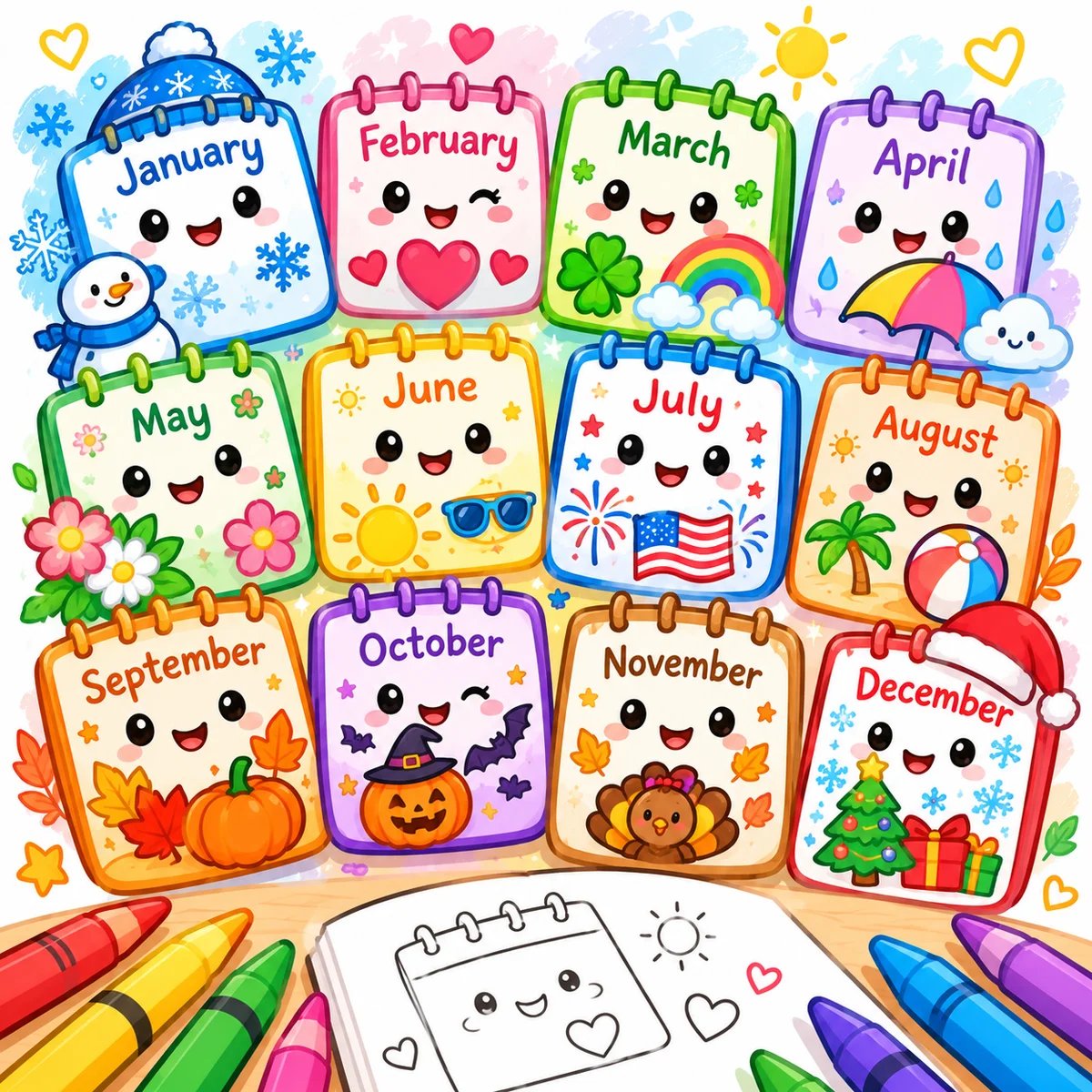
Never staple all twelve months together in January. Hand a six-year-old or an ambitious planner fan a full twelve-page stack of months coloring pages on New Year's Day, and excitement vanishes before February arrives. When April showers, July picnics, and October jack-o'-lanterns all get colored with the exact same five primary crayons, every month blurs into a repetitive chore. Treating each monthly sheet as a fresh first-of-the-month ritual complete with its own seasonal color quartet and high-contrast bubble lettering turns twelve simple printouts into a living calendar.
How the Four Quarter Palette Wheel Gives Every Month Its Own Mood
Watch a classroom or kitchen table tackle a multi-page calendar pack, and you will see kids grab the same cherry red, grass green, and sky blue markers for every single sheet from winter to autumn. By the fourth page, their hands get bored because nothing on the paper signals that the light outside the window has changed.
In the 1890s, French impressionist Claude Monet painted his famous Haystacks series twenty-five times across changing months to prove that winter frost, spring morning mist, and late-summer heat demand completely different pigments. When we curate our master library of printable coloring pages for families and teachers, we divide the twelve months into four seasonal color quartets. Swapping just four crayons or markers in a desktop cup on the first morning of each month keeps the entire year feeling brand new.
- Quarter One Frost to Early Thaw (January, February, March): Pair glacier blue, silver-gray, and warm cocoa brown for January mittens and snowmen; shift to dusty rose, cranberry red, and winter cardinal plum in February; then wake the sheet up with shamrock green, daffodil yellow, and windy slate gray for March kites and clovers.
- Quarter Two Rain Showers to Full Bloom (April, May, June): Combine periwinkle rain-cloud blue, puddle aqua, and pastel lilac for April umbrellas and ducklings; layer peony pink, honeybee gold, and terracotta pot orange for May watering cans and strawberries; then brighten into sunlit lemon, ocean turquoise, and coral peach for June seashells and watermelon slices.
- Quarter Three High Sun to Orchard Harvest (July, August, September): Anchor July cookout and sparkler sheets with ruby red, royal navy, and brass gold; blend sunflower ochre, ripe cantaloupe orange, and pool-tile cyan for August popsicles; then transition into McIntosh apple red, school-bus yellow, and cedar-pencil rose for September backpacks and oak acorns.
- Quarter Four Autumn Ember to Winter Solstice (October, November, December): Contrast pumpkin-spice orange, midnight violet, and cauldron lime for October crescent moons and cats; warm November gratitude wreaths with cranberry crimson, sage green, and roasted chestnut; and finish December with pine-needle green, holly berry red, and candlelit gold.
"Rotating four crayons in a wooden cup on the first morning of every month makes an old box of art supplies feel brand new twelve times a year."
Three Sign Painter Tricks That Keep Bubble Letter Month Names From Disappearing
Every monthly coloring sheet revolves around one central anchor: the big hollow letters spelling JANUARY, MAY, or OCTOBER across the page. Yet if you walk past a school bulletin board or flip through a home binder, you can barely read the month names from five feet away.
That visual muddle happens when the artist colors both the hollow bubble letters and the surrounding seasonal icons in the exact same mid-tone saturation. If the word OCTOBER is colored medium orange and sits right on top of medium-orange pumpkins and autumn leaves, the letters vanish into the background. Borrowing three quick sign-painter tricks guarantees your month header jumps off the sheet in under ninety seconds.
- Enforce the 70/30 Value Contrast Rule First: Decide before uncapping a pen whether your letters or your surrounding illustrations will carry the dark pigment if the winter holly and pinecones around DECEMBER are rich forest green and crimson, keep 70% of the letter interiors pale buttercream, icy blue, or white with tiny polka dots.
- Blend a Horizon Split-Fill Across the Word: Lightly rule a straight horizontal pencil line right through the middle of the entire month title, fill the upper half of every letter with a bright sunlit tint like lemon yellow or aqua, and blend the bottom half into a deeper cousin shade like tangerine or navy for an instant retro postcard glow.
- Anchor Letters With a Two-Millimeter Right-Edge Drop Shadow: Run a crisp two-millimeter stripe of charcoal gray, deep indigo, or dark plum strictly along the right-hand vertical wall and bottom curve of each letter to make the word float half an inch above the background art.
Matching Monthly Sheet Layouts to How Toddlers Kids and Adults Read Time
Handing a three-year-old a thirty-one-box calendar grid is just as frustrating as handing a high schooler a giant smiling sun with five rays. Developmental psychologist Jean Piaget demonstrated that human beings do not grasp abstract calendar time until around age seven or eight; before that milestone, young children measure the year strictly through weather, clothing, and sensory routines.
Picking the right monthly layout means matching how the person holding the crayon actually experiences time. We organize monthly printables into three distinct architectural formats so every age group gets a sheet they can genuinely use for thirty days.
Preschool Sensory Weather Sheets With Dotted Uppercase Tracing
For children ages three to five, the word "November" or "April" has zero connection to a seven-column number chart. Toddlers and preschoolers anchor months in their memory by connecting the spoken name to what they put on their bodies before walking out the front door zipping a puffy coat, pulling on yellow rain boots, or crunching dry leaves.
Choose uncluttered sheets from our printable coloring pages for kids that pair one or two large seasonal characters like a bear holding an umbrella for April or a snowman wearing a scarf for January with bold, dotted uppercase letters (J-A-N-U-A-R-Y) across the top. Having a preschooler trace the straight lines and curves of the letters with a jumbo crayon before coloring the coat and boots links early phonics directly to the season outside.
Half Page Blank Calendar Grids That Build Number Sense
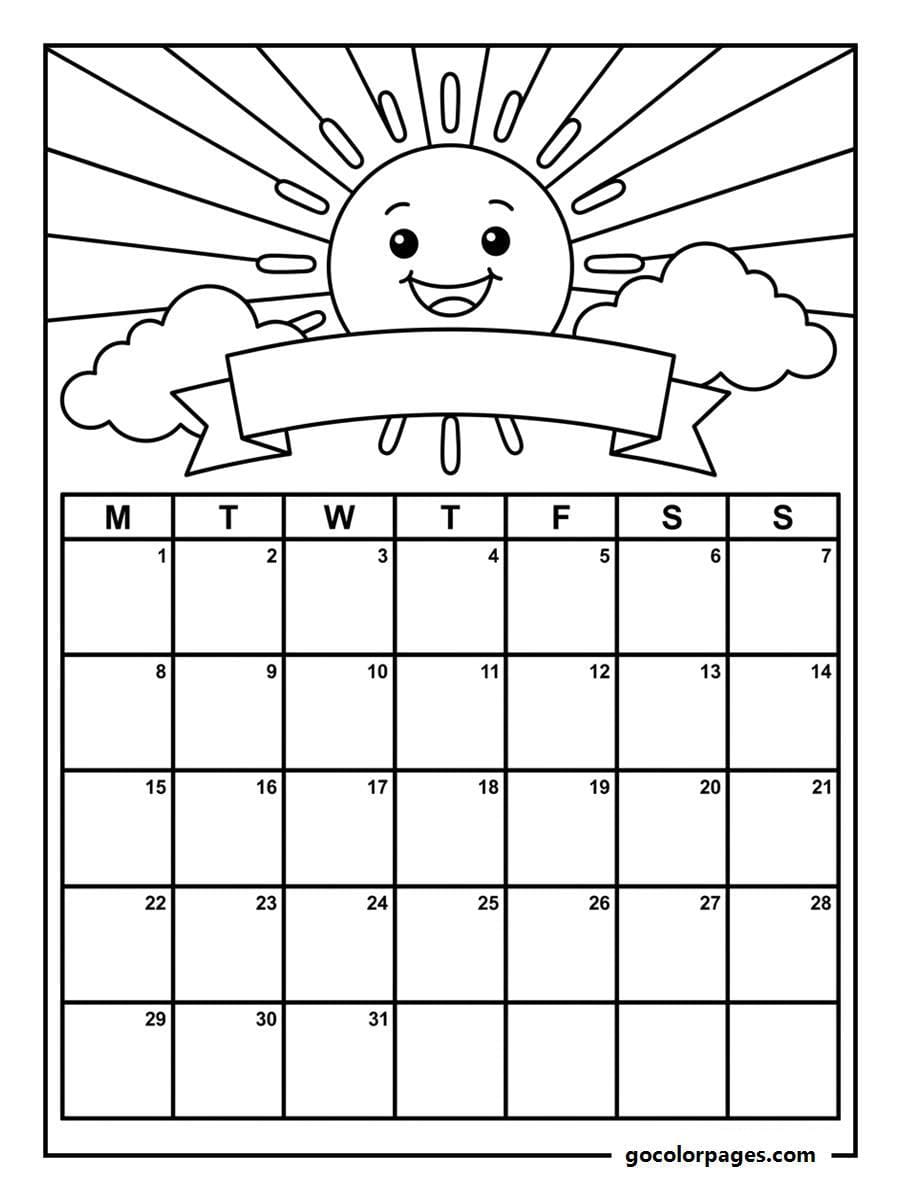
Once children enter first through fifth grade, they are ready to see how days stack into weeks. The most effective layout for ages six to ten splits an 8.5 by 11 inch sheet horizontally: the top half features a seasonal illustration banner with bubble lettering, and the bottom half provides a blank seven-column, five-row calendar grid.
Instead of printing pre-numbered sheets, give elementary kids a blank grid on the first day of the month. Having them look up which weekday the 1st lands on and hand-write the numbers 1 through 28, 30, or 31 teaches ordinal number fluency (1st, 15th, 31st) and why February is shorter than July. Once numbered, kids can draw tiny birthday cupcakes, soccer balls, or library book icons inside specific date squares.
Birth Month Flowers and Thirty Day Habit Trackers for Teens and Adults
Teens and adults rarely want a basic school calendar, which is why Ryder Carroll's Bullet Journal (BuJo) community turned monthly coloring covers into a daily mindfulness ritual. Whether you prefer thick-line cute and easy coloring pages for quick alcohol-marker washes or fine-line intricate adult coloring pages for colored pencils, two monthly layouts stand out for older artists.
- Traditional Birth-Month Flower Dividers: Centered botanical wreaths featuring each month's historic flower from January carnations and May lilies of the valley to July water lilies and October marigolds make elegant A5 binder tabs and planner cover sheets.
- Thirty-Icon Daily Mood and Habit Trackers: Instead of coloring the entire page on Day 1, choose a monthly tracker drawn with thirty or thirty-one small uncolored objects such as bookshelf spines, teacups, raindrops, or autumn leaves and color just one icon each night to log a daily reading, hydration, or walking streak.
Four Year Round Keepsakes That Save Monthly Sheets From the Recycling Bin
Standalone coloring sheets usually get taped to the refrigerator for a weekend before disappearing into the recycling bin. Monthly coloring pages carry a built-in chronological superpower: when you save all twelve sheets from January to December, you hold a complete visual time capsule of a child's school year or a family's seasons.
With a three-hole punch, a length of twine, or a pack of laminating pouches, you can turn a twelve-sheet download into a fixture that works all year long.
- The "How My Hand Grew" 12-Month Binder Portfolio: Have your child color one monthly cover page on the first Monday of every month, sketch a tiny self-portrait in the corner using simple shapes from our how to draw guides, and slip all twelve into a three-ring binder; comparing January's heavy scribbles beside December's shaded borders gives families a priceless record of fine-motor growth across 365 days.
- The Classroom Birthday Clothespin Garland: Punch two top holes in all twelve colored month headers, string them along ten feet of jute twine across a classroom or playroom wall, and clip wooden clothespins labeled with each student's or sibling's name and birth date onto the bottom edge of their birth month.
- Reusable Dry-Erase Fridge Calendars: Slide a finished half-grid monthly sheet inside a clear plastic page protector or seal it with self-adhesive laminating film so kids can color the seasonal woodland foxes and ocean turtles from our animals coloring pages crossover headers permanently in crayon, then wipe and rewrite the calendar dates every year with a fine-tip dry-erase marker.
- Half-Size Birth Flower Birthday Cards: Set your printer dialog to "2 Pages Per Sheet" to print miniature A5 birth-month botanical pages onto folded cardstock, giving kids and adults a custom, hand-shaded birthday card that matches the recipient's exact birth month.
"A single coloring page shows what a child can do on a Tuesday afternoon; twelve dated monthly sheets bound together show who they became over an entire year."
Frequently Asked Questions About Months Coloring Pages
How do I teach preschoolers the order of the 12 months with coloring pages?
Never drill all twelve abstract month names in a single sitting. Group the printouts into four seasonal trios of three months each, hang the current trio at your child's eye level, and point to the matching weather clothes and nature symbols like April umbrellas or October pumpkins during morning routines.
How can I make the bubble-letter month name stand out from a busy background?
Follow the 70/30 value contrast rule so your letters and background never share the same darkness level. If you color the surrounding wreaths, snowflakes, or beach balls with rich, dark markers, fill the inside of the bubble letters with pale pastel tints and trace a two-millimeter dark drop shadow along the right and bottom outer edges.
What are the traditional birth-month flowers to color for each month of the year?
Each month carries two classic botanical symbolseal for colored-pencil shading: carnation or snowdrop for January, violet or primrose for February, daffodil for March, sweet pea or daisy for April, lily of the valley for May, rose for June, water lily or larkspur for July, gladiolus or poppy for August, aster or morning glory for September, marigold for October, chrysanthemum for November, and narcissus or holly for December.
Can I print monthly coloring pages at half size for an A5 bullet journal or planner?
Yes, open your printer settings and choose "2 Pages Per Sheet" or set custom scaling to 70% to fit standard A5 (5.8 by 8.3 inch) planner rings and notebooks. Trim along the crop marks, punch six holes along the inside margin, and slip the colored sheet in as a durable monthly tab divider or thirty-day habit tracker.
Print This Month's Sheet and Try the Horizon Split Fill Tonight
You don't need to wait until January 1st or the first week of school to start a monthly coloring ritual. Pull up the sheet for the current month right now and try these two quick upgrades in under ten minutes.
- Shade One Month Title With the Horizon Split-Fill (5 minutes): Print this month's page, draw a faint horizontal pencil line straight across the middle of the bubble letters, and blend a bright sunlit color on the top half into a deeper cousin shade on the bottom half with a two-millimeter right-edge drop shadow.
- Stage a Four-Crayon Seasonal Cup on the Table (3 minutes): Pick the four signature colors from this quarter's seasonal palette wheel and stand them in a coffee mug beside your printout so anyone walking past the table can color one seasonal icon or daily tracker item in two minutes.
When you print out a set of monthly coloring pages, are you using them to build a classroom or kitchen calendar, set up a bullet journal cover, or save a twelve-month memory binder for your kids?