
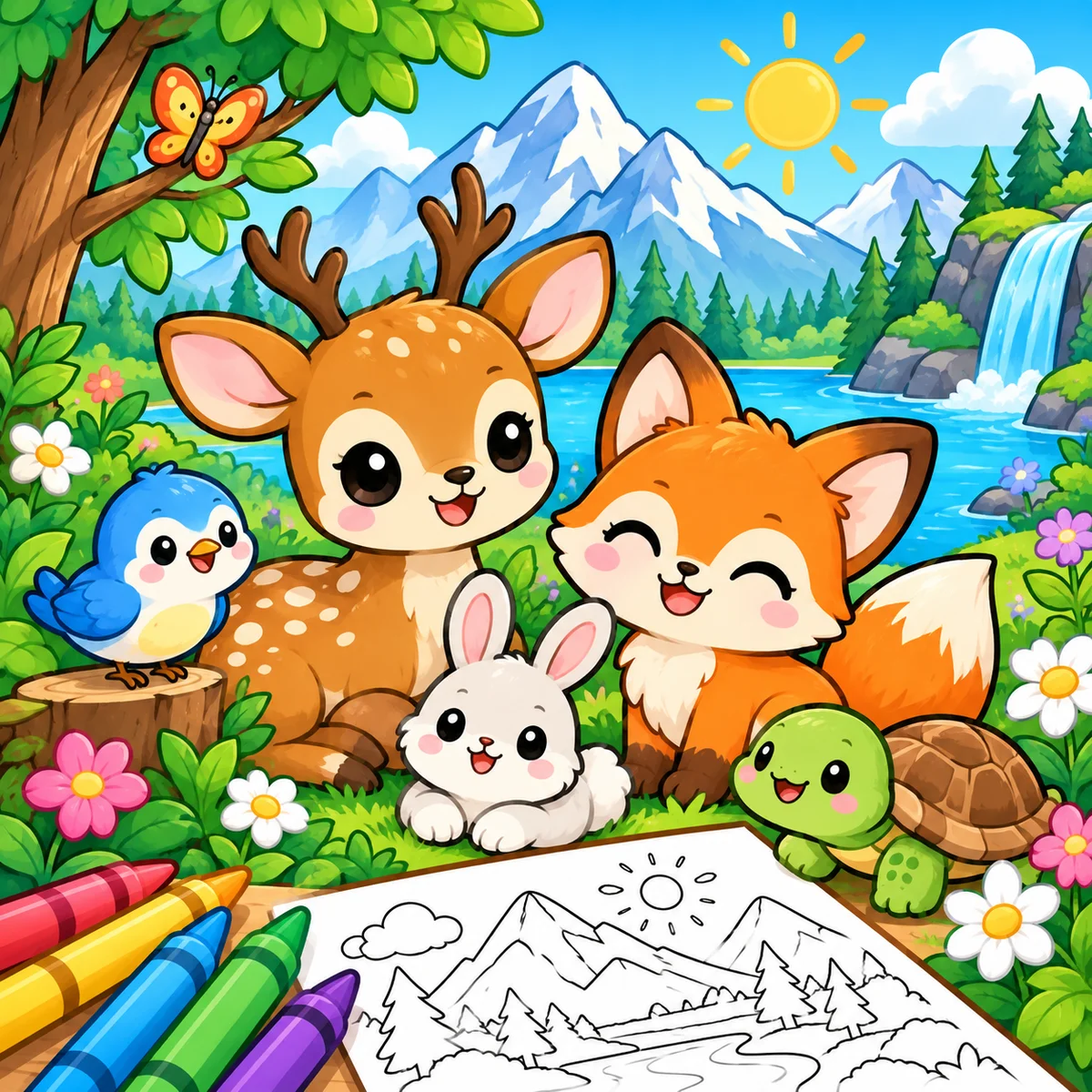
Nature coloring pages are a year-round refuge for screen-weary adults, homeschooling parents, and elementary earth-science classrooms. Yet if you have ever watched someone color a redwood forest, a mountain valley, or a summer garden with a single "forest green" marker or draw a two-inch blue stripe across the top edge of the paper for a sky you know how quickly an outdoor scene collapses into a flat wall of spinach. Because living landscapes stack dozens of overlapping leaves, rocks, and clouds on top of one another, single-color fills erase all sense of fresh air and distance.
Across 190 botanical illustration workshops and outdoor classroom labs, we discovered that making black-and-white scenery breathe on paper has nothing to do with owning a hundred-count marker case. It comes down to sorting sheets by camera distance, shifting foliage temperatures across three spatial planes, and letting bare white paper carry the light on moving water.
- Curate Sheets Across Six Outdoor Scales: Organize your printouts into Alpine Mountain Vistas, Wildflower Pollinator Meadows, Mossy Mushroom Floors, Crashing Coastal Tides, Celestial Weather Horizons, and Cozy Terrarium Jars so your hand knows whether to lay down wide sky washes or fine botanical strokes.
- Break the Wall of Green With Three-Plane Depth: Mix lemon yellow into warm foreground leaves, anchor midground trees in balanced olive and sap green, and glaze distant mountain ridges in cool slate blue or dusty lavender so the horizon drops miles back.
- Bring Skies to the Tree Line and Keep Water 85% Bare Paper: Fade daytime skies from deep overhead cobalt down to warm horizon cream, buffer orange sunsets with a thin ribbon of pale turquoise, and leave rushing waterfalls mostly uncolored white paper to capture wet foam.
One green crayon ruins a forest. Hand a child or an exhausted adult a fresh stack of nature coloring pages from misty pine valleys to backyard flower beds and watch what happens first. Almost everyone pulls a single grass-green stick from the tin and scrubs it across the oak canopy, the fern undergrowth, and the rolling hills until the entire landscape disappears into flat green camouflage. When you separate outdoor scenes into three temperature planes and let bare white paper carry the sunlight on moving water, flat black outlines open up like a real window.
Six Outdoor Collections From Alpine Peaks to Mossy Forest Floors
Dumping five hundred random tree, leaf, and ocean sheets into a single folder guarantees decision fatigue before you even sharpen a pencil. "Nature" isn't a single visual style coloring a fifty-mile Grand Canyon overlook demands a completely different hand motion than shading the delicate gills underneath a cluster of woodland chanterelles.
When we organize our master library of printable coloring pages for families, science teachers, and botanical hobbyists, we sort outdoor templates by their spatial "camera lens" rather than alphabetical order. Knowing whether your sheet is a wide-angle panoramic vista or a six-inch macro close-up tells you immediately which tools to pull from your drawer.
- Alpine Mountain Vistas and National Park Overlooks: Jagged granite peaks, winding switchback trails, canyon arches, and mirror-still glacial lakes built with three distinct depth layers for sweeping sky gradients.
- Botanical Wildflowers and Pollinator Meadows: Sunflowers, English lavender stalks, coneflowers, and trailing ivy wreaths whose radiating petals pair naturally with animals coloring pages featuring honeybees and monarch butterflies.
- Ancient Woodlands, Mushrooms, and Mossy Floors: Close-up studies of gnarled oak bark, spotted amanita and morel mushroom rings, unfurling fiddlehead ferns, and fallen logs rich in warm ochres, umbers, and sage greens.
- Coastal Tides, Seashells, and Tropical Shores: Curling ocean waves, rocky tide pools, spiral nautiluses, and driftwood coves that give your hand a break from woodland foliage with turquoise, coral, and wet-sand blends.
- Dramatic Weather, Night Skies, and Celestial Horizons: Double rainbows arcing over rolling pastures, summer lightning storms, swirling aurora borealis ribbons, and crescent moons above silhouetted pine ridges.
- Cozy Backyard Terrariums and Windowsill Gardens: Hanging glass-jar succulents, potting-shed watering cans, and backyard campfires that bridge cute and easy coloring pages for fifteen-minute alcohol marker sessions and printable coloring pages for kids.
"Before you uncap a single pen, ask whether the sheet puts you fifty yards back at a mountain overlook or six inches from a mossy log that camera distance dictates your entire palette."
How to Break the Wall of Flat Green and Build Mile Deep Landscapes
Watch ten people color a woodland trail or a jungle waterfall, and nine of them will reach straight for the standard green crayon and color every leaf, bush, and hill the exact same shade. Five minutes later, the foreground ferns disappear into the background pines like military camouflage.
Five hundred years ago, Leonardo da Vinci filled his notebooks with observations on aerial perspective, a principle later perfected by nineteenth-century Hudson River School landscape painters like Thomas Cole and Albert Bierstadt. Because outdoor air holds moisture and dust, warm wavelengths of light scatter as distance increases meaning objects right in front of your boots look warm and high-contrast, while mountains five miles away shift into cool, misty blues and lavenders.
You don't need a 120-count artist tin to capture that atmospheric depth or avoid monotone foliage. By combining just three basic pencils lemon yellow, true grass green, and dark indigo blue across three spatial planes, you can mix five distinct botanical greens and push your horizon miles back into the sheet.
- Warm Up the Foreground With Chartreuse and Golden Ochre: Glaze bright lemon yellow or golden ochre directly over your green base on the fern fronds, grass blades, and wildflower leaves closest to the bottom edge of the page so they catch full sunlight and step forward.
- Anchor the Midground in Balanced Olive and Sap Green: Blend a light touch of burnt sienna or warm terracotta into your green across middle-distance shrubs, riverbank reeds, and oak canopies to mimic sun-warmed afternoon chlorophyll.
- Push Distant Mountains and Treelines Back With Indigo and Lavender: Never color faraway hills dark brown or bright emerald; glaze cool indigo over green for deep shadow pines, and shade the farthest mountain ridges exclusively in pale slate blue, periwinkle, or dusty lilac.
Three Plein Air Secrets for Glowing Skies, Moving Water, and Craggy Bark
Unlike character or animal portraits that sit against blank backgrounds, landscape sheets ask you to color open air, transparent water, and weathered stone. Those wide, unstructured zones intimidate beginners more than any other part of the page.
If you treat the sky and the river like solid walls of blue paint, the outdoor magic evaporates. Use these three plein-air landscape habits to make air feel breathable, water look wet, and tree trunks feel rooted in the dirt.
Bringing Skies and Sunsets All the Way Down to the Tree Line
Almost every child starts coloring outdoor scenes by drawing a two-inch blue ribbon across the very top border of the paper, leaving a wide band of dead white space hovering above the trees. Real atmosphere doesn't stop thirty feet in the air it wraps all the way down behind every branch and mountain peak.
To color a believable daytime sky without streaks, apply the zenith-to-horizon fade: press firmly with cobalt or sky blue along the top edge of the sheet, then gradually lighten your hand pressure as you move downward, blending pale warm cream or mint green right where the sky meets the distant ridge. When coloring a fiery sunset, never blend orange directly into overhead blue since orange and blue are complementary opposites, overlapping them turns your clouds into muddy brown soup. Always lay a narrow five-millimeter buffer of pale lemon yellow, rose pink, or light turquoise between the warm orange horizon and the deep violet-blue upper sky.
Making Lakes, Rivers, and Waterfalls Look Wet and Moving
Filling a mountain lake or a rushing waterfall edge-to-edge with a single dark blue marker makes the water look like freshly poured blue concrete. Moving water is a mirror and a prism at the same time it reflects the colors standing above it while breaking light into bright white foam.
When coloring a calm pond or lake, keep your pencil or brush strokes strictly horizontal from left to right. Mirror a soft band of olive green directly beneath shoreline pine trees, blend sky blue toward the middle, and leave a broken vertical ladder of bare white paper down the center to mimic dancing sun ripples. For cascading waterfalls and crashing ocean surf, leave eighty-five percent of the falling water completely bare white paper, adding only thin vertical streaks of icy aqua near the top crest and pooling deep teal behind the wet boulders at the base.
Texturing Craggy Tree Bark, Mossy Stones, and Flower Petals
As anyone learning how to draw outdoor landscapes from life quickly notices, coloring a tree trunk flat chocolate brown makes a two-hundred-year-old oak look like a smooth cardboard mailing tube. Living bark and canyon rocks are built from rough, broken fractures that catch light on one side and trap moss on the other.
Instead of shading tree trunks with smooth up-and-down strokes, pull ragged, broken vertical dashes of dark burnt umber and cool slate gray down the shadowed side of the cylinder, warm the sunlit edge with golden ochre, and tuck emerald green moss into the root flares where the trunk meets the soil. On river boulders and stone pathways, stipple tiny clusters of warm gray, terracotta, and pale lichen green dots along the bottom-right shadow curve so every stone feels heavy and weathered.
Why Natural Fractal Patterns Quiet Screen Fatigue for Kids and Adults
There is a measurable biological reason why twenty minutes with a botanical or mountain coloring sheet resets your mood faster than scrolling a phone or coloring rigid city grids. In 1989, environmental psychologists Rachel and Stephen Kaplan introduced Attention Restoration Theory (ART), demonstrating that natural environments trigger effortless "soft fascination," which allows the prefrontal cortex to recover from directed screen fatigue.
Physicist Richard Taylor later pinpointed the exact visual geometry behind that calm: natural fractals. From the branching veins of an oak leaf and the spiral florets of a sunflower to cumulus cloud edges and curling ocean waves, outdoor forms repeat self-similar curves at a mid-range fractal dimension (DDD) between 1.3 and 1.5. Human eyes evolved to scan that exact 1.3-to-1.5 fractal density outdoors, reducing visual processing strain and lowering cortisol markers by up to sixty percent compared to sharp man-made rectangles.
- Preschool Backyard Weather and Bug Sheets (Ages 3 to 5): Bold 3-point outlines of smiling suns, raindrops, acorns, and single daisies with 6 to 10 wide zones that let toddlers connect indoor crayon time with what they pick up in the yard.
- Elementary Ecosystem Cross-Sections (Ages 6 to 10): Split-level pond, rainforest, and tide-pool scenes showing roots and burrows underground alongside canopy branches above, turning art time into an interactive science map.
- Botanical Apothecary Plates and Vintage Park Posters (Teens and Adults): Detailed floral specimens, mushroom field guides, and alpine vistas inside our intricate adult coloring pages collection that deliver multi-evening fractal immersion.
"Your eyes don't get tired from looking at detail they get tired from harsh digital rectangles; curving fern fronds and mountain ridges reset visual focus because your brain was wired outdoors."
Turning Finished Nature Printouts Into Leaf Rubbings and Window Sun Catchers
The best nature coloring session doesn't stay locked inside a desk folder when the last petal is shaded. Because botanical and landscape sheets mirror what is growing right outside your door, you can combine printed line art with real leaves, sunlight, and weekend trail walks in under ten minutes.
These three studio and classroom crafts bridge indoor coloring with tactile outdoor exploration using basic household supplies.
- Backyard Leaf-Rubbing Canopy Plates (Frottage): Before coloring a tree canopy or autumn wreath with markers, gather two dry oak, maple, or fern leaves from outside and slip them vein-side up underneath your coloring sheet; rub the flat side of a peeled green or golden wax crayon over the page to transfer authentic leaf veins right into the printed branches.
- Two-Drop Oil Translucent Window Sun-Catchers: Once you finish coloring a wildflower meadow, sunset mountain, or stained-glass butterfly garden with heavy crayon or colored pencil, flip the sheet face-down on scrap newspaper, rub two drops of baby oil or kitchen vegetable oil across the back with a cotton ball, and blot dry taped to a sunny window, the paper fibers turn translucent and glow like real glass.
- Pocket National Park and Trail Explorer Passports: Print four landscape or botanical sheets onto a single 8.5 by 11 inch page using your printer's "4-Up" layout setting, fold and staple them into a pocket A6 field booklet, and challenge kids to match their pencil shades to real bark, lichens, and wildflowers on a weekend walk.
Frequently Asked Questions About Nature Coloring Pages
How do you color a forest or nature scene without everything looking the same shade of green?
Never rely on a single green crayon or marker for an entire landscape. Use your standard green as a base, then glaze lemon yellow over foreground leaves to create bright sunlit chartreuse, blend a touch of warm brown or burnt sienna into midground bushes for olive, and shade distant background pine trees with cool indigo or slate blue.
How do you color realistic water, lakes, and waterfalls on a coloring page?
Skip solid edge-to-edge blue fills that make water look like flat paint. On still lakes, pull horizontal side-to-side strokes that echo the green of nearby shoreline trees and leave a broken vertical column of bare white paper down the center for sun reflection; on waterfalls, leave eighty-five percent of the falling water bare white paper and tuck icy aqua and deep teal strictly into the top lip and bottom splash pool.
How do you blend a sunset sky without the orange and blue turning muddy brown?
Orange and blue sit directly across from each other on the color wheel, so overlapping them creates a dull gray-brown cloud. Always place a narrow five-millimeter buffer zone of pale lemon yellow, soft rose pink, or light turquoise between your warm orange horizon and your cool blue upper sky so the transition glows cleanly.
Why does coloring nature scenes and botanical patterns feel more relaxing than abstract shapes?
Environmental psychology research shows that curving natural fractals such as fern fronds, flower petals, mountain ridges, and ocean waves match the 1.3-to-1.5 fractal density our visual cortex evolved to read outdoors. Tracing and shading those organic curves triggers "soft fascination," allowing your brain's directed attention center to rest and recover from rectangular screens.
Step Outside for Two Leaves and Try the Five Green Trick Tonight
You don't need a wooden field easel or a forty-eight-piece set of botanical pencils to make your next outdoor sheet look like a sunlit window. Try these two quick landscape experiments at your table right now in under ten minutes.
- Mix Five Greens From Three Pencils on One Leaf Cluster (4 minutes): Pull just one lemon yellow, one true green, and one dark indigo or blue pencil from your drawer, then layer yellow-over-green on the sunlit leaf tips and blue-over-green in the stem shadows to watch flat foliage spring into 3D focus.
- Run a Sixty-Second Backyard Leaf Rubbing Under Your Sheet (3 minutes): Grab a single dry leaf from your yard or a courtyard walkway, slide it vein-side up underneath a tree or garden coloring page, and rub the flat side of a peeled crayon across the canopy to lock real botanical texture into your print.
When you print a fresh stack of nature sheets to unwind after a long day, do you find yourself reaching first for wide-open mountain and ocean horizons, or close-up woodland details like wildflowers, ferns, and forest mushrooms?