Most beginners who sit down to learn how to draw Odie accidentally sketch a regular hound dog with a giant skull and a tiny tongue. That single mistake ruins the joke before your pencil even reaches his ears. When cartoonist Jim Davis introduced Garfield's lovable, drooling sidekick on August 8, 1978, he stripped away almost every realistic canine bone and built Odie out of pure rubbery exaggeration. His eyes float straight off the top of his head without a forehead line, his snout juts out like a yellow balloon, and his tongue practically has its own zip code. You don't need an art degree or fancy drafting rulers to capture that goofy Sunday-paper charm. If you can write the letters O, U, S, and D, you can put Odie on paper in under ten minutes. Grab a pencil, keep your wrist loose, and let's build Garfield's favorite punching bag line by line.
Gathering Simple Drawing Supplies Before Your First Sketch
You only need a standard 2B graphite pencil, a soft eraser, a black fineliner pen, and four basic markers or crayons to draw Odie cleanly. Keeping your toolkit minimal prevents stiff, overworked lines and helps you mimic the brisk, spontaneous brushwork of classic newspaper comic strips.
Comic strip characters live or die by clean line contrast rather than heavy pencil shading. If you press too hard during the initial sketch, erasing overlapping guidelines around Odie's eyes and tongue will leave muddy gray ghosts on the paper. A light-handed pencil setup paired with smooth alcohol markers for comic shading gives you crisp black contours and flat, vibrant Sunday-strip color fills.
- 2B Graphite Pencil - Soft enough to glide across paper with feather-light pressure while staying easy to erase cleanly once your ink dries.
- Kneaded or Vinyl Eraser - Lifts away overlapping construction lines inside Odie's ears and paws without scuffing the paper surface.
- Waterproof Black Fineliner (0.5mm and 0.8mm) - Creates the bold, slightly varied outer comic outlines that make Jim Davis's characters pop off a white page.
- Smooth Marker or Bristol Paper - Prevents yellow and brown ink from bleeding across your black outlines during the final coloring stage.
Understanding Why Jim Davis Designed Odie With Three Simple Ovals
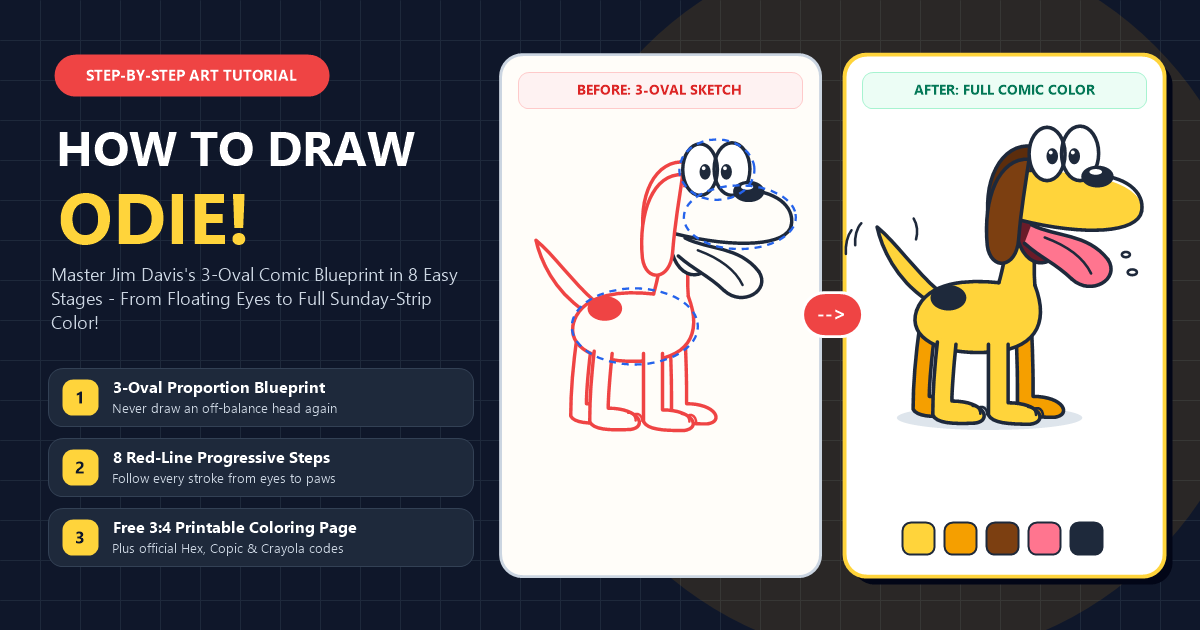
Jim Davis constructed Odie using three distinct ovals a vertical eye cluster, a wide horizontal snout, and a compact kidney-bean torso connected by a skinny tube neck. Mapping these three shapes lightly before adding details guarantees that his head stays delightfully oversized compared to his body.
If you study beginner cartoon dog proportions, you'll notice that most animated pups have a round cranial dome holding their eyes and ears together. Odie breaks that rule completely. His two tall oval eyes serve as the highest point of his head, and his bulbous muzzle projects forward at a ninety-degree angle like a furry shelf. Even more surprising is the size of his body. From chest to rump, Odie's torso is barely as wide as his snout and tongue combined. Linking that top-heavy face to a small bean-shaped body via a slender, slightly curved neck is the real secret behind his eager, bobblehead posture.
Following the Eight Step Visual Blueprint for How to Draw Odie
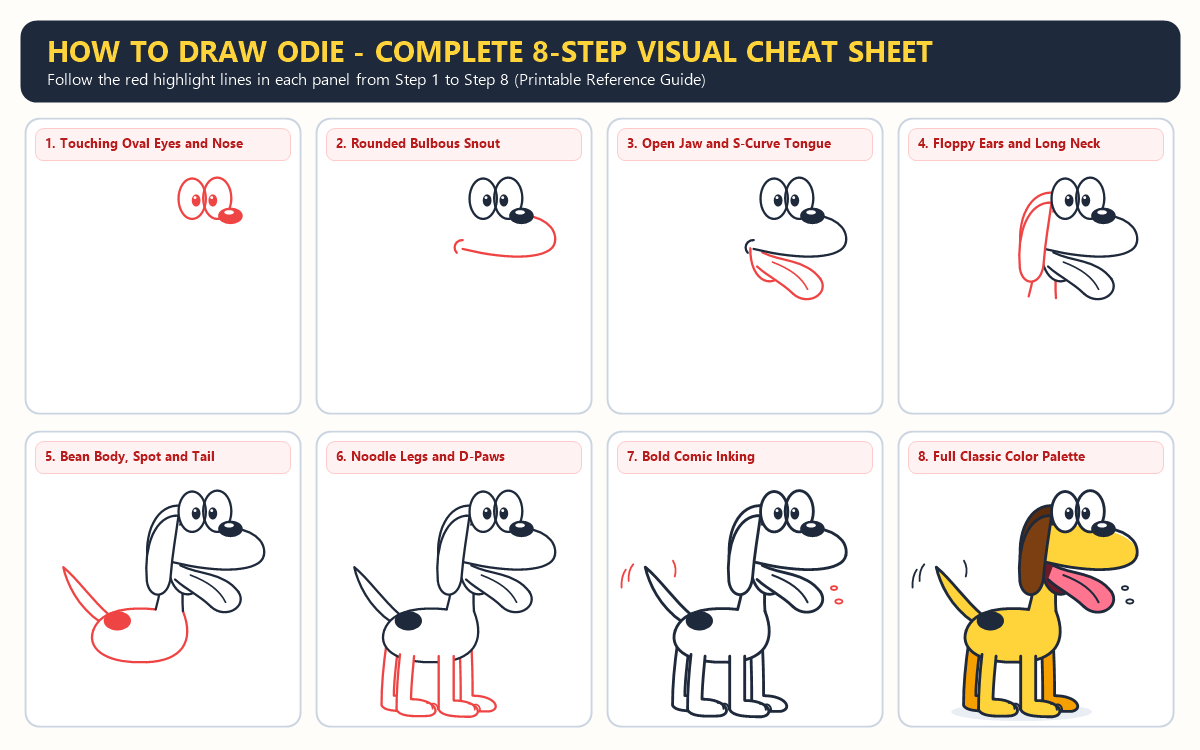
Learning how to draw Odie step by step works best when you start from his eyes and build downward toward his paws, using each finished shape to measure the next. In every illustration below, the bright red lines show exactly what to add in your current stage while previous lines turn black.
Easy Odie Drawing Step by Step
The new lines in each picture show what to add next. Simple shapes will come together to make your odie. Let’s begin!
Step 1: Starts With Two Giant Touching Oval Eyes and a Button Nose
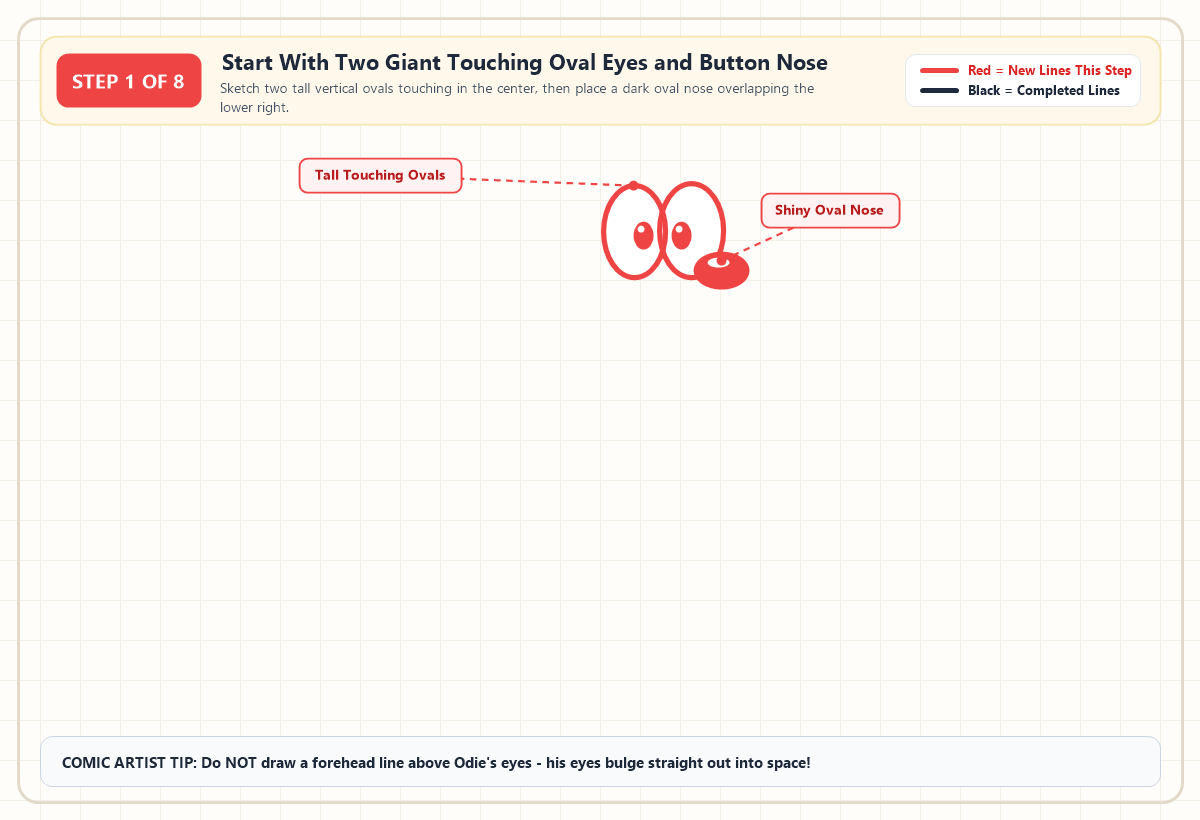
Begin near the upper center of your sheet by drawing two tall, vertical ovals right next to each other so their inner edges touch like the number 88 turned on its side. Make the right eye just a fraction taller than the left to create three-quarter comic depth. Inside the lower center of each eye, fill in a smaller dark oval pupil, leaving a tiny white circle uncolored near the top edge for a lively cartoon sparkle. Right below the spot where the two eyes meet slightly overlapping the bottom of the right eye draw a plump horizontal black oval for his nose, keeping a thin white crescent highlight across the top.
Step 2: Shapes the Rounded Bulbous Snout and Wide Cheek Curve
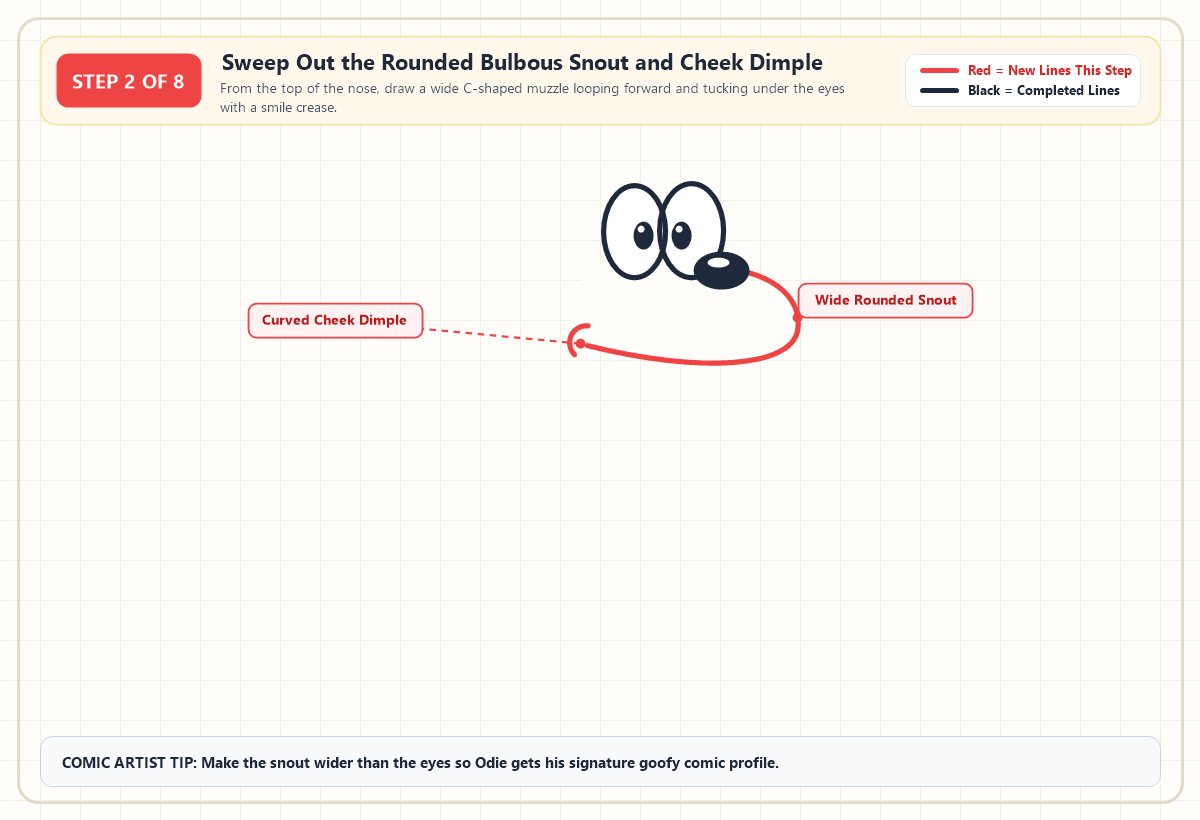
Place your pencil at the upper right edge of Odie's nose and sweep a wide, generous C-shaped curve out to the right, looping down and back underneath the eyes to form his puffed-out snout. Think of this shape as an inflated sideways water balloon. Carry the bottom line of the snout slightly past the left edge of his left eye so it becomes a wide, happy upper lip. Cap the left end of that lip line with a short, C-shaped cheek dimple arc this tiny parenthesis immediately gives Odie his trademark vacant grin.
Step 3: Brings Out the Open Jaw and Signature S Curve Tongue
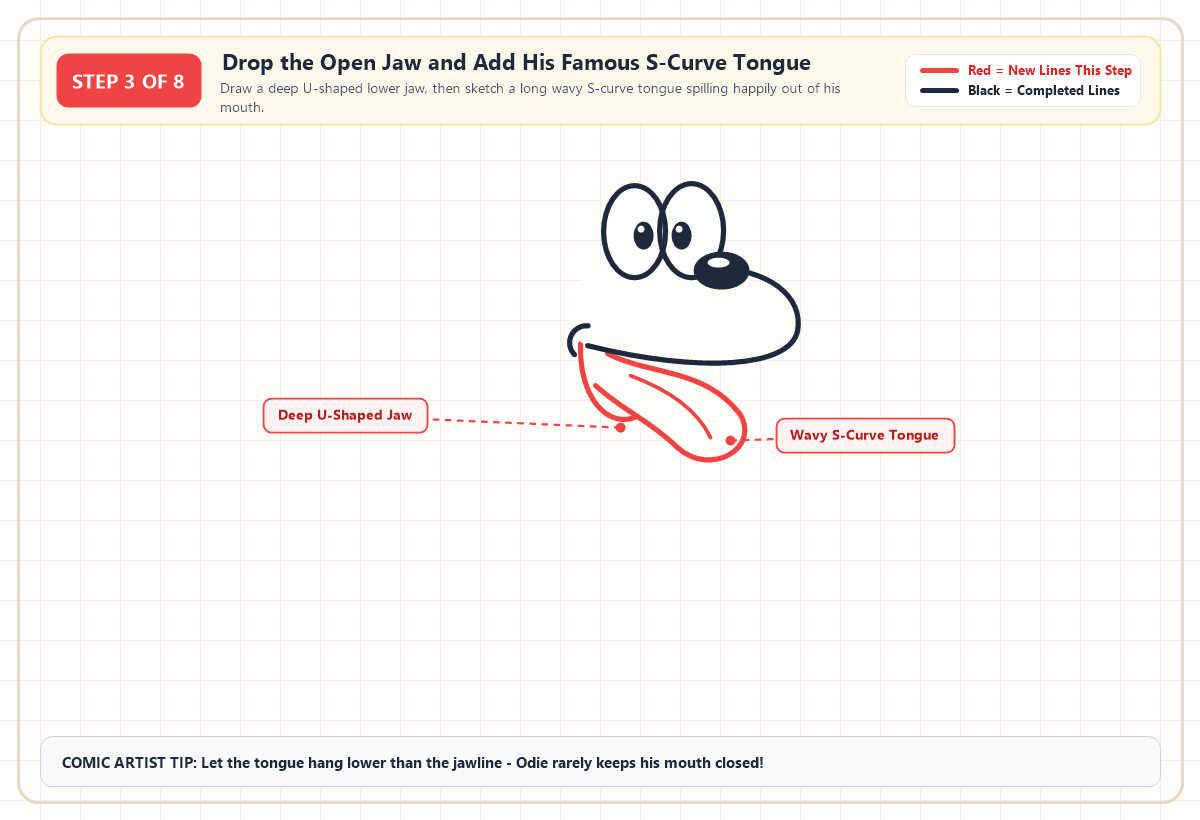
Just inside the cheek dimple under the left eye, drop a deep U-shaped loop downward and curve it back up toward the middle of his snout to create his wide-open lower jaw. Now comes the most recognizable feature in the entire Garfield universe. Starting inside the upper throat, draw a long, flowing S curve tongue that spills out over his lower jaw and curls down past his chin with a rounded tip. Add a single gentle curve down the middle of the tongue to show its center groove. Don't be shy with the length here a short tongue makes Odie look polite, and Odie is never polite.
Step 4: Adds the Long Floppy Ears and Slender Comic Neck
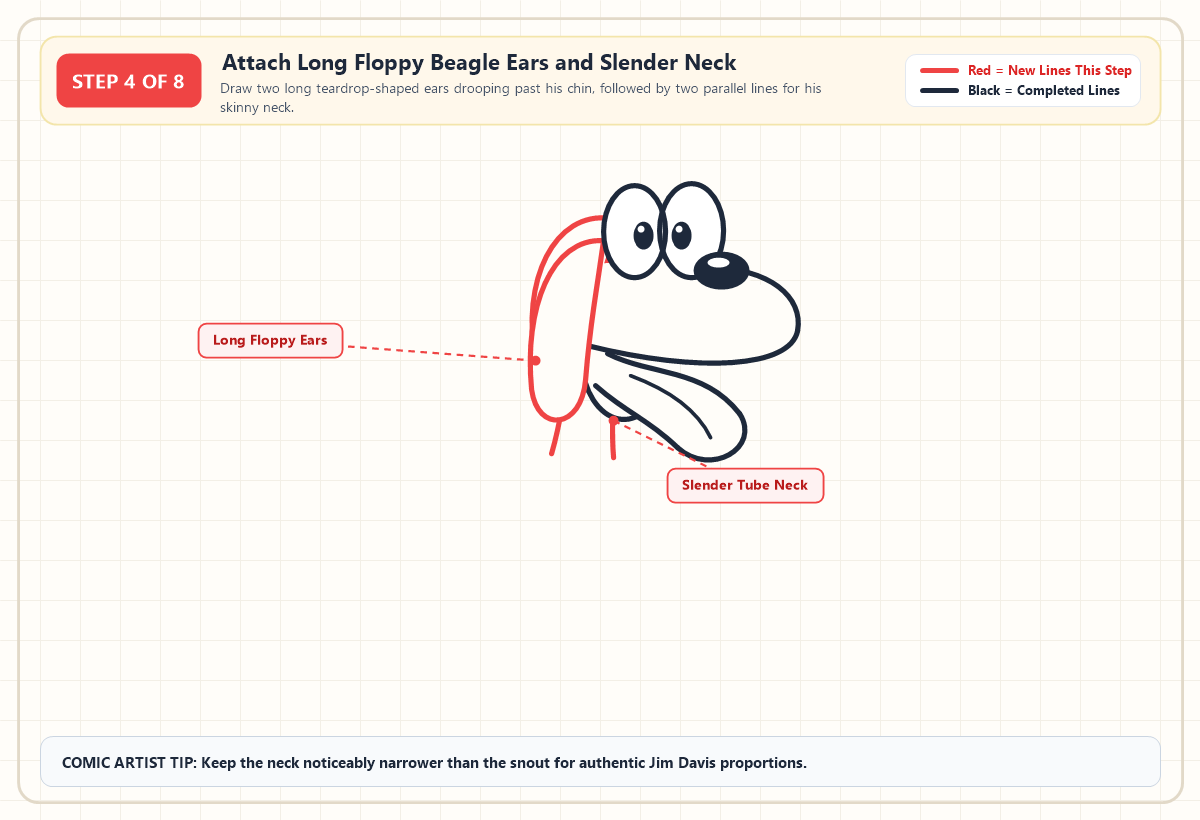
Tuck your pencil against the outer left edge of Odie's left eye and draw a long, drooping teardrop shape that hangs all the way down past his jawline for his near ear. Keep the bottom tip thick and rounded like a wooden paddle. Behind that ear, sketch a second curved ear silhouette peeking out from the back of his head to give your drawing dimension. Next, drop two slender, nearly parallel vertical lines downward from the underside of his jaw to form his long, goofy neck.
Step 5: Builds the Bean Shaped Torso With His Classic Back Spot
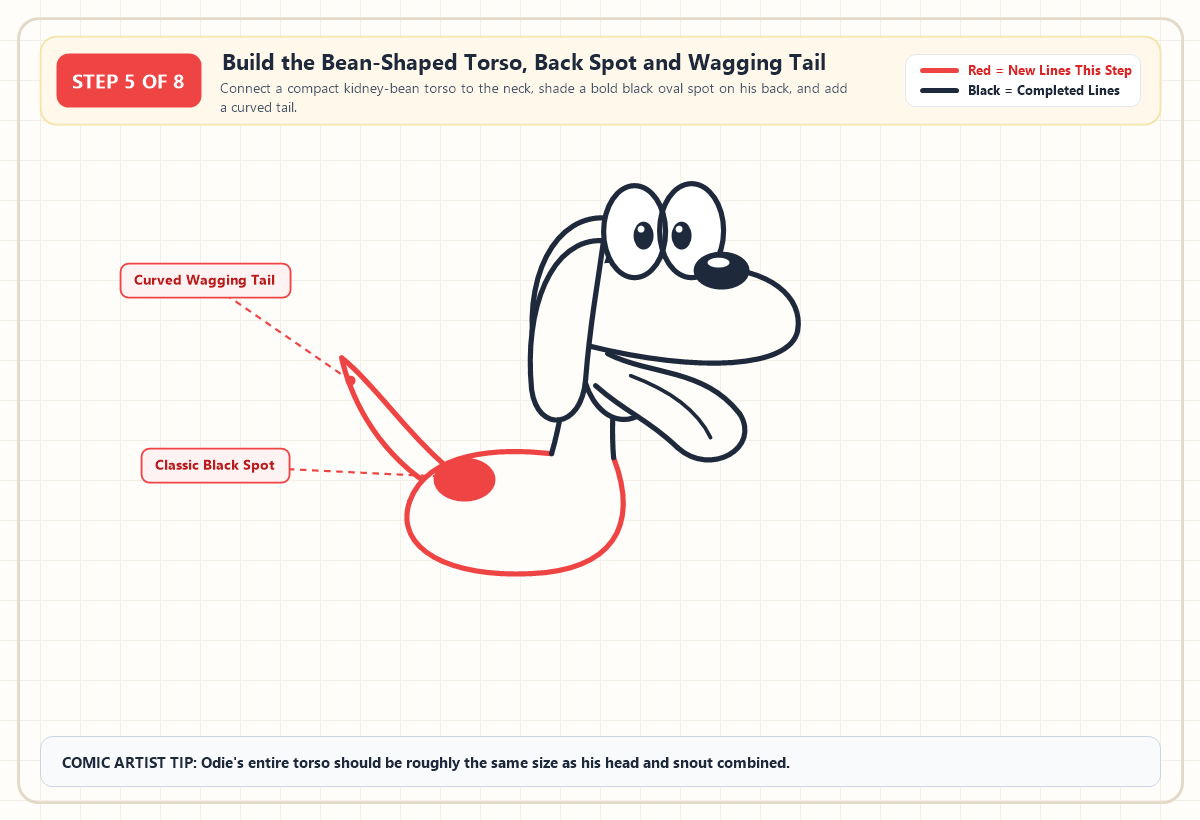
From the base of the left neck line, sweep a smooth horizontal line backward to form his short back, curve it around into a rounded rump, and loop it underneath into a plump belly that reconnects with the front of his neck. The whole torso should look like a sideways kidney bean. Right where his back curves into his hip, draw and fill in a bold, solid black oval spot. Finish the rear end by extending two tapering curved lines upward at a forty-five-degree angle that meet at a point for his perky tail.
Step 6: Connects the Noodle Legs and Chunky D Shaped Paws
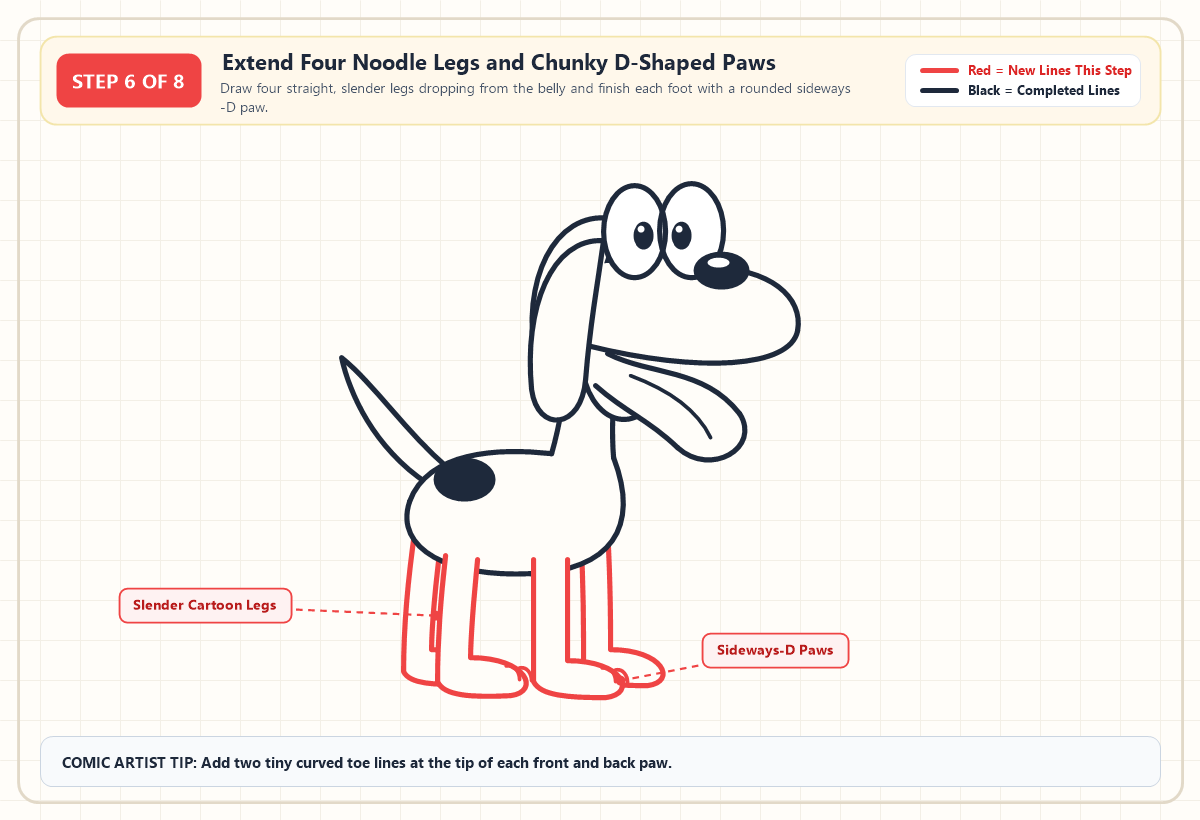
Drop two pairs of straight, slender vertical lines down from the underside of Odie's chest and belly to build his four skinny cartoon legs. Keep the back pair of legs slightly staggered behind the front pair so all four feet remain visible. At the bottom of each leg, draw an oversized, rounded paw that stretches forward like a capital letter D lying flat on its back. Sketch two small curved toe lines near the front tip of the near paws to separate his toes.
Step 7: Locks In Bold Comic Ink Lines and Action Marks
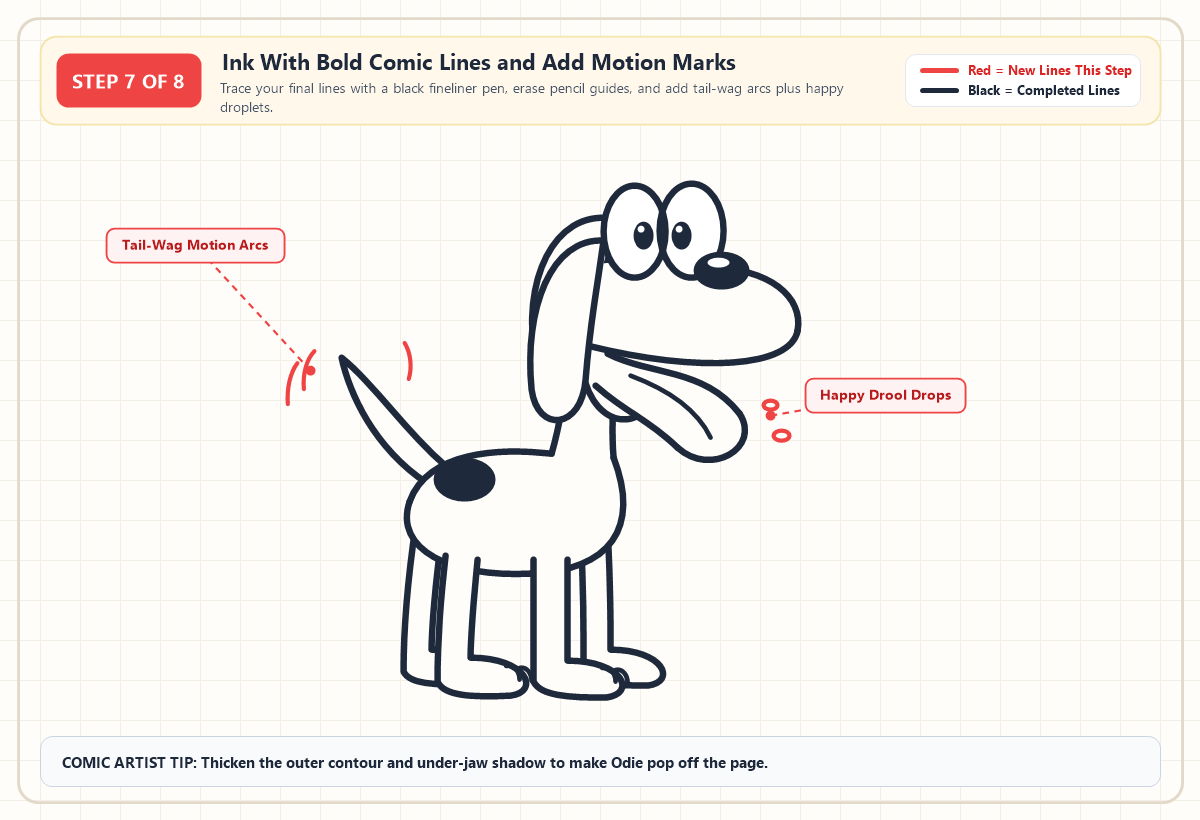
Switch to your black fineliner pen and trace confidently over your finished pencil sketch, pressing slightly harder along the outer contour of his snout, belly, and paws to create classic comic line weight. Wait sixty seconds for the ink to dry completely, then sweep a clean eraser across the page to remove every underlying pencil guideline. To bring your ink drawing to life, add two curved parenthesis motion lines on either side of his tail and two tiny floating teardrop ovals right off the tip of his tongue.
Step 8: Fills In the Golden Yellow Fur and Warm Brown Ears
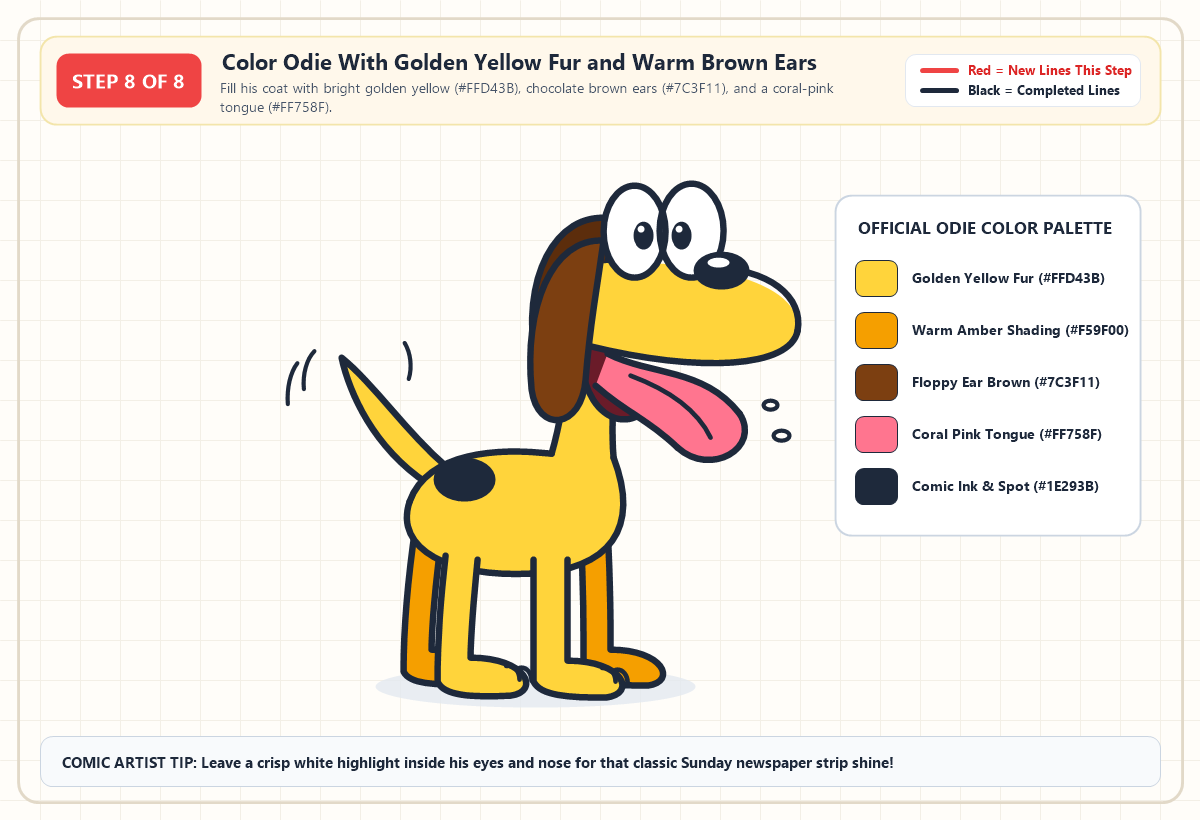
Bring Odie into full Sunday-strip color by laying down a bright golden yellow (#FFD43B) across his snout, neck, torso, tail, and near legs. Use a slightly deeper warm amber (#F59F00) on his two far legs to push them visually into the background. Fill his near floppy ear with rich chocolate brown (#7C3F11) and shade the back ear a darker espresso brown (#5C2D0C). Color his long tongue vibrant coral pink (#FF758F), fill the open mouth cavity behind the tongue with deep maroon (#6A1B29), and make sure the white highlights inside his eyes and nose stay completely untouched.
Printable Odie Drawing PDF
Download the printable PDF to use now or save for later — it prints on A4 and Letter paper.
Print PDFComparing Classic Comic Strip Odie With His Modern Movie Look
While Jim Davis's 1978 comic strip Odie combines Beagle colors with pure rubber-hose cartoon shapes, recent film adaptations have reimagined his design in two distinct ways. Whether you want to draw the traditional newspaper version, the 3D animated Garfield Movie pup, or list exact marker shades, the reference matrix below breaks down every visual difference.
| Visual Feature | Classic 1978 Jim Davis Comic Odie | 3D Animated Movie Odie (2024 Style) | Official Color & Marker Reference |
|---|---|---|---|
| Breed Inspiration | Yellow Beagle cartoon caricature ("Purebred Clown") | Scruffy Beagle-Terrier animated hybrid (Live-action used a Wire-haired Dachshund) | Base Fur Hex #FFD43B / Copic Y15 / Crayola Goldenrod |
| Eyes & Forehead | Tall touching ovals floating with zero forehead line | Slightly separated 3D eyes recessed into a furry brow ridge | Eye Whites #FFFFFF with Jet Black #1E293B pupils |
| Ears & Texture | Smooth, paddle-shaped floppy brown ears hanging past the chin | Shorter, slightly frayed brown ears that bounce outward | Ear Brown Hex #7C3F11 / Copic E37 / Crayola Sepia |
| Snout & Tongue | Huge smooth balloon muzzle with an S-curve tongue | Compact muzzle with a softer, textured pink tongue | Tongue Pink Hex #FF758F / Copic RV23 / Crayola Carnation Pink |
| Back Spot & Paws | One solid black oval spot on the lower back; flat D-shaped paws | Soft-edged dark patch with individual sculpted paw pads | Spot & Ink Hex #1E293B / Far-Leg Shadow #F59F00 |
Fixing Three Proportion Mistakes Beginners Make When Sketching Odie
Even experienced doodlers can end up with an off-model Odie if realistic dog habits sneak into their pencil strokes. Catching these three common proportion traps early will save you from wearing out your eraser.
- Drawing a skull dome above his eyes - In real dogs, a forehead wraps around the eyes, but in Garfield, adding a head line above Odie's eyes makes him look like he's wearing a helmet. Always let the upper halves of his two oval eyes rise straight into open space.
- Making the neck too thick and short - If Odie's neck is as wide as his jaw, he loses his goofy, eager posture. Keep the two vertical neck lines roughly one-third the width of his snout so his head looks comically heavy.
- Aligning all four paws on the exact same horizontal line - Placing all four feet on a single flat ruler line makes your character look like a cardboard cutout. Stagger the two far paws about a quarter-inch higher than the near paws to create instant floor depth.
Frequently Asked Questions About Sketching Garfield Characters
What is the easiest part to start with when learning how to draw Odie?
The easiest and most reliable place to start drawing Odie is his pair of tall, touching oval eyes right in the upper-middle of your paper. Because Jim Davis designed Odie without a forehead line, anchoring his eyes and button nose first gives you an instant ruler to measure the width of his snout, ears, and body.
What dog breed is Odie supposed to be in Garfield?
In Jim Davis's original 1978 comic strip, Odie is modeled after a yellow Beagle with oversized brown ears, though Garfield jokingly calls him a purebred clown. Originally owned by Jon Arbuckle's roommate Lyman, Odie was portrayed in the live-action films as a wire-haired Dachshund and terrier mix.
Why do Odie's eyes float above his head without a forehead line?
Floating eyes are a signature visual gag created by cartoonist Jim Davis in the late 1970s to exaggerate expressions in small newspaper panels. By omitting the skull line behind the upper half of Odie's and Garfield's eyes, their pupils can bulge, tilt, and widen freely without being cramped inside a realistic head shape.
What exact colors do I need to color Odie accurately?
You only need five core colors to match Odie's official Sunday comic strip palette: bright golden yellow (#FFD43B) for his fur, warm amber (#F59F00) for his far legs and belly shading, rich chocolate brown (#7C3F11) for his floppy ears, coral pink (#FF758F) for his tongue, and jet black (#1E293B) for his back spot and nose.
Bringing Your Own Cartoon Strip to Life Next to Garfield
Now that you have a wide-eyed, tail-wagging Odie grinning up from your sketchbook, don't leave him standing alone on blank paper. Sketch a small blue food bowl beside his front paws, or draw a table edge right behind his rump so it looks like he's waiting for a nudge. Better yet, pair your finished pup with our step-by-step guide on how to draw Garfield so the grumpy orange tabby can glare at Odie's enthusiasm in a full three-panel comic strip of your own.